Full-Funnel Marketing
Research to revenue — one system.
Awareness through conversion to retention, run as a single loop by one team — so growth stops leaking in the gaps between agencies, channels and handoffs.
Full-Funnel Marketing runs every Azivra service under one operating plan: research feeds angles, angles feed creative, creative feeds media, and results feed a shared memory across channels. One growth lead owns one number, re-plans happen quarterly on the data, and the AI Growth Audit is the entry point.
-
3.4×
average ROAS lift
Average across three client accounts in real estate, B2B SaaS and healthcare; clients not named.
-
500+
variants from one brief
-
The tension
Funnels break at the seams: research never reaches creative, creative never reaches media, and media learnings die in a dashboard instead of feeding the blog.
-
The shift
One system runs the whole line. Research feeds angles, angles feed creative, creative feeds media, results feed memory — if a topic ranks, ads pick it up; if a cold email gets replies, it becomes next week’s blog.
-
The outcome
Every channel compounding the others. One brief in, a coordinated funnel out — and agents that get smarter every week.
What you get
Concrete, not fluff.
-
Every service under one operating plan
-
A single shared memory across channels
-
One growth lead, one number
-
Quarterly re-plans driven by the data
-
The AI Growth Audit as the entry point
How it works
Brief in, live campaign out.
-
Research
-
Create
-
Launch
-
Measure
-
Remember
It loops — every cycle feeds the next.
The proof
The shape of the curve is the argument.
Because each cycle inherits what the last one learned, performance accelerates instead of plateauing.
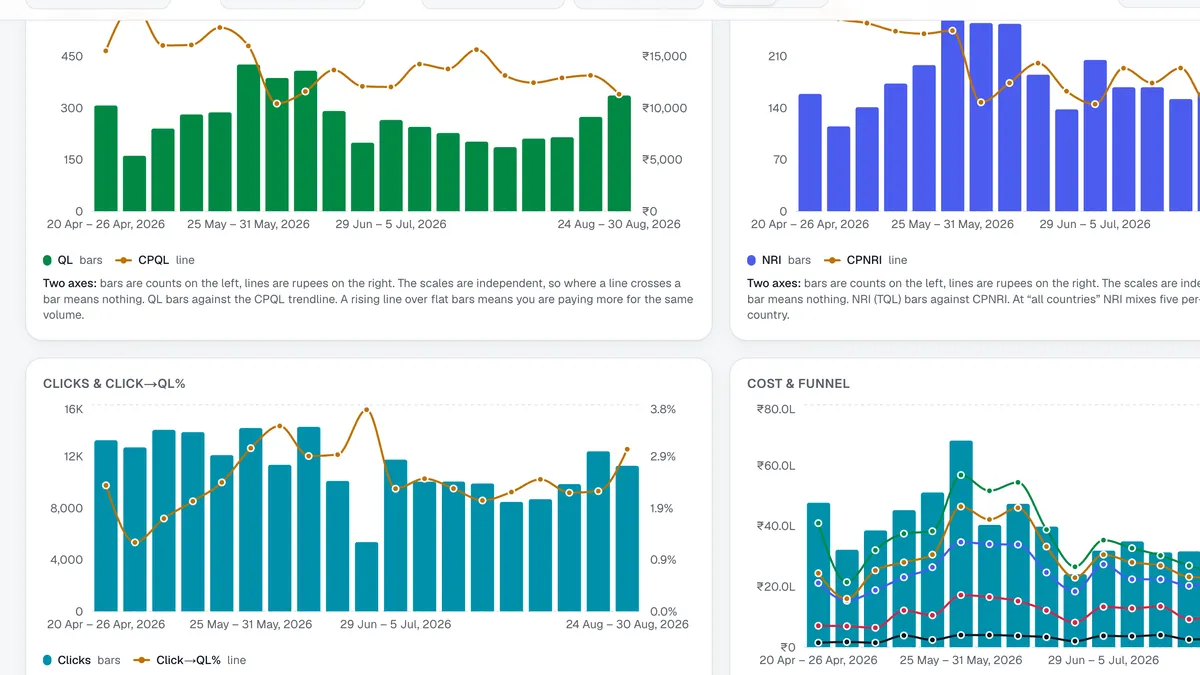
A direct-to-consumer brand consolidated separate ads and search agencies into one funnel; within a quarter blended return rose and acquisition cost fell as top-of-funnel learnings fed conversion creative. Directional, not a named client.
FAQ
Frequently asked questions
-
No, and it is usually a bad idea. Most engagements start with the two channels where the seam is costing most, prove the loop works there, and widen from evidence.
-
Then the loop runs around them rather than instead of them. The common split is that your team owns brand, offer and category judgment, and we own throughput, measurement and the parts nobody has time for.
-
One team owns the blended number. That is the structural difference — when each channel owns its own metric, every channel can hit target while the business misses.
-
The first cycle is just a baseline. The effect is visible once several cycles have fed each other, which in practice means a quarter — and it keeps widening after that, which is the whole point.